How Wholesale Blast Compressors Are Powering the Metal Fabrication Boom
- Shanxi Jyc
- Jun 9
- 5 min read

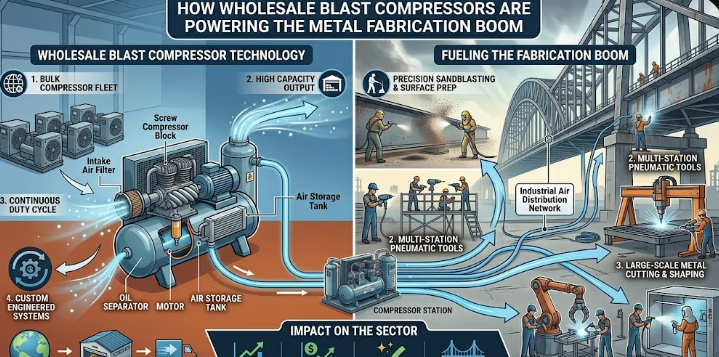
The global metal fabrication industry is in the middle of a significant growth surge — driven by infrastructure expansion, automotive demand, shipbuilding activity, and the rise of advanced manufacturing.
Walk into any steel fabrication plant, structural metalwork facility, or industrial welding shop, and you'll find compressed air running through nearly everything. Pneumatic tools, sandblasting rigs, plasma cutting systems, surface finishing equipment — all of it depends on a reliable, high-performance blast compressor to keep production moving. As the metal fabrication sector scales up globally, so does the demand for powerful, energy-efficient, and cost-effective compressed air solutions.
For fabrication businesses operating at volume — whether running a single large facility or managing multiple production sites — sourcing through wholesale channels has become a strategic advantage. A reliable Wholesale Blast Compressor supplier offers not just cost savings but consistency of supply, bulk availability, technical support, and access to the latest compressor technology at competitive price points.
What is a blast compressor and why does metal fabrication depend on it?
A blast compressor is a high-output industrial air compressor designed to deliver large volumes of compressed air at the sustained pressure levels required for abrasive blasting, pneumatic tooling, plasma cutting, and other heavy-duty metal fabrication processes. Unlike standard shop compressors built for light or intermittent use, blast compressors are engineered for continuous, demanding operation — delivering the CFM (cubic feet per minute) and PSI (pounds per square inch) output that metal fabrication workflows demand.
In the metal fabrication industry, compressed air is not a utility it is a production-critical resource. A drop in air pressure or an unreliable supply can halt an entire assembly line, delay surface preparation schedules, or compromise the quality of finished metalwork. This is why fabricators at scale invest in industrial-grade blast compressors with sufficient capacity, redundancy, and durability to support continuous production shifts.
Surface preparation and sandblasting: the highest demand application
Of all the applications in metal fabrication, abrasive sandblasting places the greatest demand on a blast compressor. To sustain effective blasting through industrial nozzles — particularly larger nozzles ranging from 8 to 13mm used in heavy steel fabrication — a compressor must deliver consistently high airflow, typically 20 CFM or more per nozzle. Any pressure drop below the required threshold reduces blasting efficiency dramatically, slowing production and increasing media consumption.
For large-scale steel fabricators, shipbuilders, and structural metalwork companies, rotary screw or diesel-powered blast compressors are the standard choice. They are built for continuous operation and deliver the sustained high-volume airflow that smaller piston compressors simply cannot maintain over extended blasting sessions.
Plasma cutting: precision compressed air at the cutting edge
Plasma cutting machines require a steady, clean stream of compressed air to generate the high-velocity plasma jet that cuts through metal. The compressed air serves as both the cutting gas and the shielding gas — ensuring a clean cut with minimal dross and a precise edge profile. Most plasma cutters for medium to heavy sheet metal require between 100 and 150 PSI of air pressure, with flow rates that demand a dedicated industrial compressor rather than a shared facility line.
Oil contamination in the air supply is one of the most common causes of plasma cut quality issues, which is why many metal fabricators are transitioning to oil-free rotary screw compressors for their plasma cutting operations — ensuring clean, dry air on every cut.
Robotic welding and automation systems
As metal fabrication facilities automate production with robotic welding arms, CNC press systems, and automated assembly lines, the demand for consistent compressed air has grown significantly. Pneumatic actuators, robotic clamping systems, and automated transfer mechanisms all rely on compressed air to operate with the speed, precision, and repeatability that modern fabrication requires. A single robotic welding cell may require continuous compressed air supply at 7–10 bar — making compressor reliability directly tied to production uptime and output quality.
Why wholesale sourcing makes sense for metal fabricators
For fabrication businesses operating at scale — whether managing a single large facility or multiple production sites — purchasing blast compressors through wholesale channels offers substantial strategic and financial advantages over retail procurement.
Lower per-unit cost — wholesale pricing significantly reduces capital expenditure when outfitting multiple workstations or facilities with blast compressors
Consistent supply — wholesale suppliers maintain inventory depth that ensures replacement units and spare parts are always available without lead-time delays
Standardized equipment across sites — buying from a single wholesale source ensures all units share compatible parts, maintenance schedules, and operator training requirements
Access to the latest technology — established wholesale suppliers carry current-generation VSD compressors, IoT-enabled systems, and energy-efficient models that deliver lower running costs
Technical and after-sales support — reputable wholesale distributors offer installation guidance, commissioning support, warranty coverage, and ongoing service agreements
Bulk customization options — many wholesale suppliers offer compressors with custom CFM, PSI, tank size, and drive configuration to match specific fabrication workflow requirements
Energy efficiency: a growing priority for fabrication facilities
Energy costs are one of the largest operational expenses for any metal fabrication facility, and compressed air systems are among the biggest energy consumers within those facilities. As energy prices rise globally, fabricators are increasingly prioritizing energy-efficient blast compressors as a way to reduce overhead and improve long-term profitability.
Variable Speed Drive (VSD) compressors have emerged as the gold standard in energy-efficient compressed air for fabrication environments. By automatically adjusting motor speed to match real-time air demand — rather than running at fixed speed regardless of load — VSD compressors can deliver energy savings of 30–45% compared to traditional fixed-speed models. In high-volume fabrication plants where compressors run 8–16 hours per day, these savings translate directly into significant cost reductions year over year.
The latest generation of blast compressors also incorporates Permanent Magnet (PM) motors with IE4 efficiency ratings, IoT-enabled monitoring platforms, and smart controllers that optimize pressure, temperature, and airflow in real time. These systems not only reduce energy consumption but also enable predictive maintenance — alerting facility managers to potential issues before they cause costly unplanned downtime.
The metal fabrication boom: what's driving demand
The surge in demand for blast compressors in the metal fabrication sector is not happening in isolation — it is being driven by a convergence of macro-industrial trends that are reshaping manufacturing globally.
Infrastructure investment is near record highs across Asia, the Middle East, and parts of North America and Europe — with massive civil engineering projects, bridge construction, high-rise development, and energy infrastructure all demanding fabricated structural steel at scale. At the same time, the automotive industry's transition to electric vehicles is generating new demand for precision metal fabricated components, battery enclosures, and chassis systems. Shipbuilding backlogs at yards in China, South Korea, and Japan remain elevated, driving sustained demand for hull fabrication and surface preparation equipment.
How to choose the right blast compressor for your fabrication operation
Selecting the right blast compressor for a metal fabrication facility requires a systematic assessment of your production requirements. Here is a practical framework to guide the decision:
Start by calculating your total air demand — add up the CFM requirements of every tool and piece of equipment that will run simultaneously at peak production, then add a 20–30% buffer to ensure pressure stability under load. This gives you your minimum compressor output requirement.
Next, determine whether your operation demands oil-free air. For plasma cutting, robotic welding, and coating applications, oil contamination is unacceptable — making an oil-free rotary screw compressor the only viable choice. For general blasting and pneumatic tool use, oil-injected compressors offer a cost-effective and reliable solution.
Consider your operational environment. Facilities with stable electrical supply benefit from the lower running costs of electric rotary screw compressors. Mobile or remote fabrication operations — including on-site structural steelwork and field maintenance — are better served by portable diesel blast compressors. For the largest fixed facilities, a combination of centralized electric rotary screw units supplemented by portable diesel units for peak demand periods is often the most practical approach.


Comments